
 |
 |
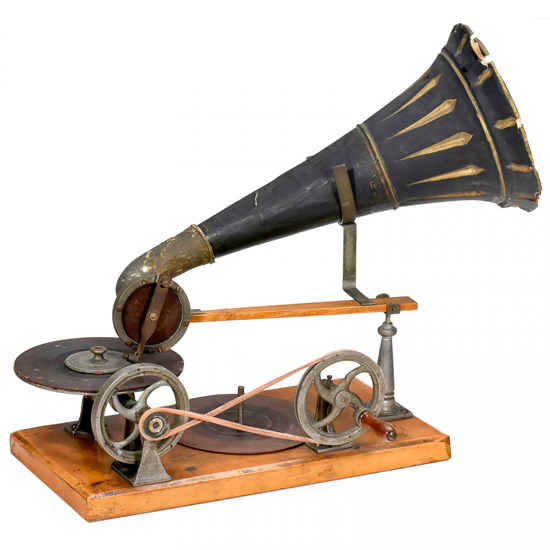
| Berliner Kämmer & Reinhardt Gramophone |
|
Emile Berliner and the Invention of the Gramophone and Disc RecordThe history of the disc-record gramophone begins with the Berliner Gramophone Company’s founder, the German-born Emile Berliner (1851-1929) who immigrated to the United States in 1870. Settling in New York, Berliner worked several jobs in his early days while he taught himself about electricity and acoustics. After moving to Washington, D.C., Berliner began to experiment in a small lab he built in his apartment. His interests led him to work on an improvement to Alexander Graham Bell’s newly invented telephone, which could benefit from improvements to the transmitter to make it a viable product. Berliner’s experiments resulted in a practical transmitter for which he applied for a patent on June 4th 1877. Berliner then sold this patent in 1878 to Bell for $50,000 and was retained as a consultant by the company. In a story told by Emile’s grandson Oliver Berliner, the original offer was for $50,000 or stock in Bell’s company. In 1986, the American government mandated that Bell Telephone would be broken up into several subsidiaries and at that time they determined that had Emile taken the shares in Bell Telephone, the value would have been $1,086,000,000.00. Berliner’s New Endeavour Berliner’s experiments were initially conducted using a method originally proposed by Leon Scott de Martinville, where sound waves were traced by a laterally (side to side) vibrating stylus onto a cylinder, wrapped with a piece of paper coated in lamp black. To record the sounds, the user would speak forcefully into a funnel which focused the sound waves onto a stylus that then traced the vibrations onto the paper by scraping off the lampblack as it passed over the surface. As the coated paper passed under the vibrating stylus, the sound waves were scribed into the lamp black by the stylus. Berliner then cut these paper cylinders into a strip in order to have them etched into a piece of flat zinc or other suitable metal such as copper or nickel using a purely mechanical process of engraving, by chemical deposition or his preferred method, a photo-engraving process. Constructing a crude reproducer by sawing off a telephone receiver
and diaphragm to which he attached a needle that extended beyond the
diaphragm, Berliner would run this along the groove in the flat zinc
plate to reproduce the original sounds recorded by his device. Although
the recordings hinted at success (producing only fragments of speech)
his results were successful enough to warrant patenting his process.
On November 8, 1887, Berliner was granted United States patent 372,786
“Gramophone” which outlined Berliner`s method of recording
and reproducing sounds using the lateral (side to side) method and included
diagrams of the basic equipment needed to achieve this. Berliner’s First Disc As was to become the practice, a point or stylus was used to hand-etch recording information on the centre of the disc, which was then given a coating of shellac to protect the undulating wave pattern, yielding a better and more permanent tracing. Early tracings were used to produce a photo-negative and then through a photo engraving process, the photo-negative was subsequently transferred to a polished zinc plate, which was then subjected to several chemical steps resulting in a finished zinc record. The First Disc Patent Although Berliner now had a process for making recordings, much more research needed to be done to develop a practical process for mass producing records. The Direct to Disc Recording Method The Disc Gramophone’s Debut Using zinc discs, which he referred to as phonautograms, he gave a
program which consisted of the following selections: Working Toward a Mass Produced Disc Public Exhibitions Berliner was very well received and his exploits garnered much interest in his invention on both sides of the Atlantic, as news of triumphant demonstrations pitting Berliner’s gramophone directly against Edison’s phonograph and wax cylinders (introduced just one year earlier) was reported in the United States. Gramophone Production Begins Gramophone Record Production Kämmer, Reinhardt records typically had paper labels with the text or title of the selection and Berliner’s two patent dates, Nov, 1887 and May, 1888 affixed to the back (labels on the fronts of records would not become common until much later). The front of these single-sided discs had “E. Berliner’s Grammophon” and the German patent number “D.R.P. 45048” (Deutsches Reichspatent) stamped into them along with the title and record number, which had either been hand-written or impressed into the original wax master. Sometimes raised lettering was used for the record number and unfortunately recording dates were not written on the discs, something that collectors and historians are grateful appear on the later 7-inch American Berliner discs. The Gramophone Reaches the Market Emile Berliner Set to Triumph In America After having modest success with his toy gramophone in Germany, Berliner
traveled back to the United States in 1890 to begin pursuing entry into
the American marketplace even though his key American patent was still
to be granted. In order to make his gramophone attractive to investors,
Berliner opened up a retail store in Baltimore, Maryland, in late 1894
to market his latest hand-driven gramophone and new 7-inch discs. After
several failed attempts to raise sufficient capital, Emile Berliner
obtained $25, 000 of financial backing which he used to incorporate
the Berliner Gramophone Company in October 1895 and set up a factory
at 1032 Filbert Street in Philadelphia, Pennsylvania, to control the
manufacture and sale of gramophones and records. |
|
 |
 |
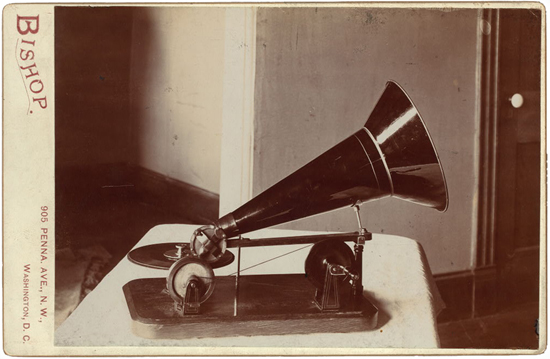
American Made Berliner Hand Driven Gramophone |
The Iconic American Made Berliner Trade Mark Gramophone |